

By INFOLITENEWS
Stakeholders in Nigeria’s education and engineering sectors have called for a comprehensive repositioning of Engineering Technical and Vocational Education and Training (TVET) to strengthen the country’s industrial development, create employment opportunities and enhance its global competitiveness.
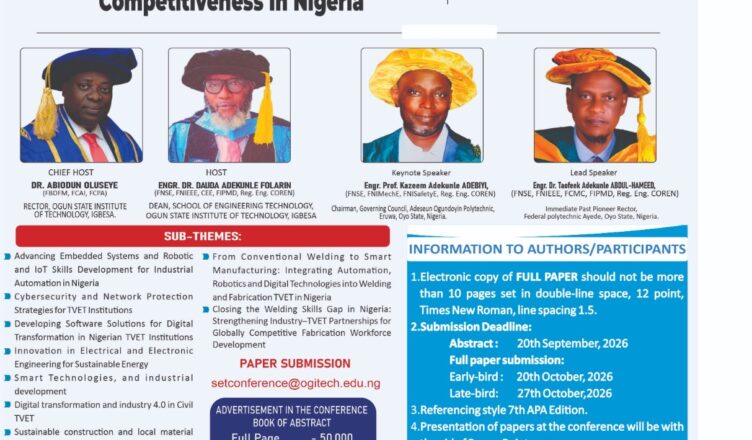
The call was made at the just-concluded 2nd Hybrid International Conference organised by the School of Engineering Technology of the Ogun State Institute of Technology (OGITECH), Igbesa, with the theme: “Repositioning Engineering TVET for Industrial Development and Global Competitiveness in Nigeria.”
The conference, held between November 2 and 5, 2026, brought together academics, engineering professionals, regulators, industry representatives, researchers and students to examine the future of technical and vocational education in Nigeria.
In his lead paper titled “From Technical Certificates to Technical Capability: Powering Nigeria’s Industrial Rise through Skills, Standards and Strategy,” the Immediate Past Pioneer Rector of the Federal Polytechnic, Ayede, Oyo State, Engr. Dr. Taofeek Adekunle Abdul-Hameed, FNSE, FNIEEE, FCMC, FIPMD and COREN-registered Engineer, stressed that no nation could achieve sustainable industrialisation on the strength of academic degrees alone.
Abdul-Hameed said Nigeria must build and respect a strong corps of technicians, technologists and craftspeople capable of translating ideas into products and prosperity.
He argued that Engineering TVET must move away from being perceived as a “second-choice” educational pathway and be repositioned as a first-class instrument for national industrial development.
The lead speaker identified a number of challenges confronting the sector, including obsolete equipment, inadequate laboratories and workshops, weak industry linkages, curriculum gaps, poor funding, limited industrial exposure for instructors and the persistent disparity in the recognition of Higher National Diploma and university degree qualifications.
He, however, proposed a seven-pillar framework for repositioning Engineering TVET, including competency-based and industry-driven curricula, strategic industry partnerships and work-based learning, staff development and industrial immersion, improved laboratories and digital infrastructure, stronger quality assurance, sustainable financing and improved recognition of technical career pathways.
Also delivering the keynote address at the official opening ceremony was Professor Kazeem A. Adebiyi, Guest Speaker and Keynote Speaker at the conference.
Professor Adebiyi described the theme as timely and strategic, noting that Nigeria could not achieve sustainable industrialisation without a practical, innovative and industry-responsive Engineering TVET system.
He observed that despite Nigeria’s growing number of engineering graduates, industries still face shortages of job-ready technicians, technologists and other skilled technical personnel capable of operating, maintaining and innovating with modern equipment.
According to him, the success of Engineering TVET should not be measured merely by the number of certificates issued but by the ability of graduates to demonstrate practical competencies that translate into productive employment, entrepreneurship and industrial growth.
Professor Adebiyi called for the modernisation of workshops and laboratories, regular review of curricula, deeper collaboration between educational institutions and industries, improved practical training and continuous capacity development for lecturers and instructors.
He also recommended stronger industry participation in curriculum development and workplace training, noting that institutions such as OGITECH, located within a major industrial corridor in Ogun State, have a strategic advantage to build partnerships with manufacturers and other productive enterprises.
The keynote speaker urged government, industry leaders, professional bodies, regulatory agencies and educational institutions to jointly reposition technical education as a major component of Nigeria’s economic and technological transformation.
He maintained that Engineering TVET should move from certificate-driven education to a competence-driven system that equips young Nigerians with the skills required to solve problems, maintain modern systems, develop products and create value.
The conference ended with a renewed call for sustained investment, stronger collaboration and practical reforms that would place Engineering TVET at the centre of Nigeria’s industrial renaissance and prepare Nigerian technical graduates for opportunities in the local and global economy.