
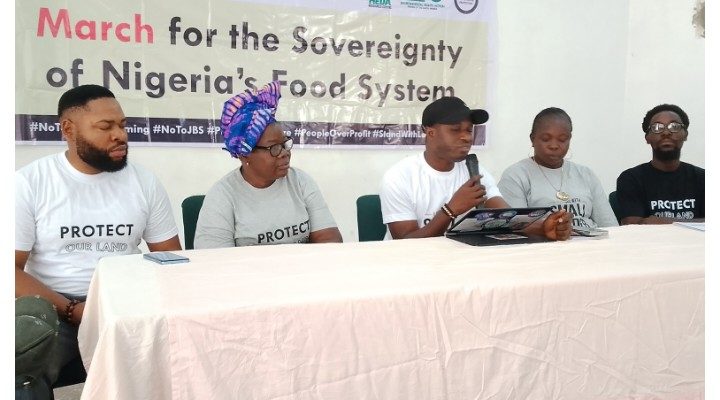

Civil society organisations, environmental advocates, farmer groups, youth organisations and concerned citizens on Wednesday called for the suspension of a proposed US$2.5 billion investment by Brazilian meat giant JBS to build six industrial livestock facilities across Nigeria, citing a lack of transparency, inadequate public consultation and risks to food sovereignty, the environment and smallholder livelihoods.
The demands were made at a sensitisation rally held at NUJ Hall in Abeokuta, Ogun State, according to a press statement released by the coalition on 13 August 2026.
The groups said the Federal Government has reportedly signed a Memorandum of Understanding with JBS and pledged favourable economic, sanitary and regulatory conditions to facilitate the project, while several states have indicated willingness to host parts of the investment. They warned that large-scale industrial animal farming carries significant risks, pointing to international investigations that have linked JBS and similar corporations to deforestation, high greenhouse gas emissions, labour and human rights concerns, and other controversies in countries where they operate.
Particular concern was raised over land. The coalition noted publicly available information that Niger State has reportedly pledged approximately 1.2 million hectares for livestock investment—potentially one of the largest corporate land allocations for livestock production on the African continent. This, they said, raises serious questions about land governance, community rights, biodiversity and the future of smallholder agriculture, which produces the majority of Nigeria’s food.
The groups also expressed worry that a significant proportion of production may be intended for export rather than meeting domestic food and nutrition needs, questioning whether the project primarily serves national food security or an extractive model prioritising external markets.
They highlighted the absence of publicly available evidence that comprehensive Environmental and Social Impact Assessments have been completed or that meaningful consultations have taken place with civil society working on food systems. Formal Freedom of Information requests submitted to relevant federal institutions and participating state governments seeking the MoU, project frameworks, environmental assessments, land allocation details and investment incentives have so far received no substantive responses, the coalition said.
“Transparency is not an obstacle to investment. Rather, it is the foundation of responsible governance and sustainable development,” the statement said. “Nigerians have a legitimate right to know the commitments being made on their behalf and to participate in decisions that may fundamentally reshape the country’s food systems, natural resources and rural livelihoods.”
The coalition called on the Federal Government and participating state governments to:
• Suspend further implementation until all project documents are publicly disclosed and independently reviewed.
• Immediately publish the MoU and related documents, including feasibility studies, Environmental and Social Impact Assessments, land allocation agreements and incentive packages.
• Respond without delay to outstanding FOI requests.
• Conduct comprehensive, independent and publicly accessible Environmental and Social Impact Assessments before any approvals or implementation.
• Ensure genuine consultation with civil society, smallholder farmers, affected communities, women, youth, independent researchers and other stakeholders before final decisions.
• Strengthen safeguards against environmental degradation and labour or human rights violations.
• Prioritise investments that strengthen agroecology, resilient local food systems and the livelihoods of Nigeria’s millions of smallholder farmers.
The coalition stressed it is not opposed to investment in agriculture but insists any project capable of transforming the food system must be transparent, accountable, environmentally responsible and shaped through inclusive dialogue rather than negotiated behind closed doors.
“Nigeria’s food future should be built on democratic participation, food sovereignty, environmental integrity and public accountability,” the statement concluded.