
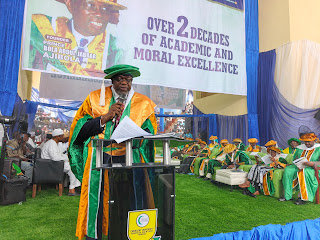

Justice Habeeb Adewale Abiru of the Supreme Court of Nigeria has issued a strong caution regarding the deployment of technology in the legal system, urging legal practitioners and policymakers to ensure that Artificial Intelligence (AI) serves as an aid to human judgment rather than a replacement for it.
Delivering the 18th Convocation Lecture of Crescent University, Abeokuta, Ogun State, on Friday, October 16, 2026, Justice Abiru addressed the intersection of technology and jurisprudence under the theme, “Artificial Intelligence and the Future of Justice: Building a Fair Society in the Digital Age.”
While acknowledging that proper regulation and implementation of AI could vastly improve access to legal information, streamline judicial administration, and curb chronic delays in Nigeria’s justice delivery system, the Supreme Court jurist warned of profound risks. Without stringent safeguards, he noted, automated systems risk reinforcing systemic discrimination, compromising citizen privacy, and generating unconstitutional outcomes.
“Constitutional guarantees of fair hearing, privacy, and freedom from discrimination remain applicable, regardless of whether decisions are made by human beings or supported by computer systems,” Justice Abiru asserted.
He further emphasized that in criminal justice administration, algorithmic predictions must never be treated as definitive proof of guilt. The long-standing legal pillars of the presumption of innocence and established rules of evidence, he insisted, must remain absolute.
To safeguard the integrity of the courts, the jurist called for robust mechanisms to mitigate algorithmic bias, protect sensitive personal data, and guarantee that any technology-influenced decision remains fully explainable and legally challengeable.
A Vision for 2030 and Academic Milestones
The lecture formed the intellectual centerpiece of a milestone celebration that saw Crescent University graduate 897 students for the 2025/2026 academic session.
In his address, the Vice-Chancellor of the institution, Professor Ibraheem Gbajabiamila, highlighted recent institutional achievements, notably the successful resource verification for four pivotal academic programmes: B.Sc. Cybersecurity, B.Sc. Software Engineering, B.Sc. Artificial Intelligence, and the Master of Laws (LL.M.) degree.
Reiterating the university’s core philosophy, Professor Gbajabiamila reminded the graduating class that the institution maintains an uncompromising stance on moral integrity, stressing that “failure in character amounts to failure in all.”
Reinforcing this forward-looking agenda, the Proprietor and Chairman of the Board of Trustees, Prince Adesegun Ajibola (SAN), revealed that the university is aggressively driving towards a transformation that will establish all its colleges as designated Centres of Excellence by 2030, coinciding with the institution’s Silver Jubilee.
Prince Ajibola commended the growing confidence of regulatory bodies and stakeholders in the university’s capacity, urging the newly minted alumni to act as worthy ambassadors of Crescent University by pairing their academic training with unyielding professional ethics and high moral standards.
Justice Abiru similarly challenged Nigerian tertiary institutions to ramp up cutting-edge research and training in data protection, cybersecurity, and digital evidence handling, preparing a new generation of professionals equipped to navigate—and shape—the digital age responsibly.