
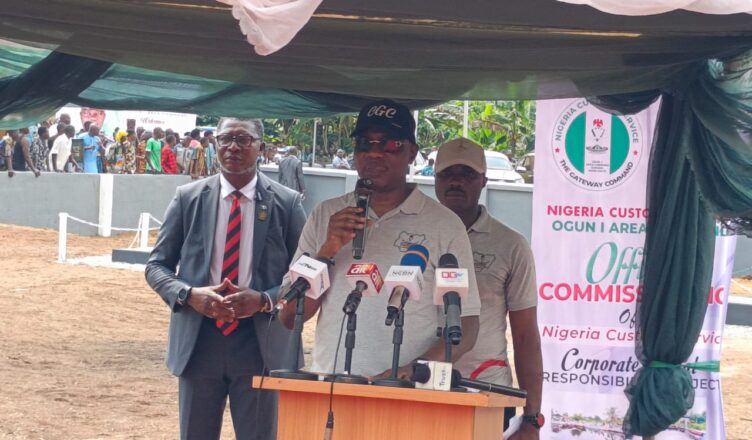

The Comptroller-General of the Nigeria Customs Service (NCS), Bashir Adewale Adeniyi, has commissioned four community development projects in Ogun State, reaffirming the Service’s commitment to infrastructure development, education, historical preservation and improved relations with border communities.
The projects, commissioned in Ijofin community, Ipokia Local Government Area, include a newly constructed jetty, the renovation of Nigeria’s first Customs office, the renovation of Ijofin Junior High School and a newly constructed Customs administrative building in Idiroko.
Speaking at the commissioning ceremony, Adeniyi said the projects demonstrated the Service’s determination to extend its contributions beyond its statutory responsibilities of revenue generation, trade facilitation and border security to initiatives that directly improve the welfare of host communities.
He explained that the success of an institution should not be measured solely by its operational achievements but also by the positive impact it makes on the lives of people and communities within its areas of operation.
“Our borders are not merely geographical boundaries. They are also spaces where our people live, where they conduct their businesses, where they raise their families and where they pursue their aspirations,” he said.
The Customs boss noted that effective border management required constructive engagement, mutual understanding and a genuine commitment to the welfare of communities surrounding operational areas.
He explained that the projects were part of his administration’s deliberate efforts to strengthen the Service’s corporate social responsibility initiatives through practical interventions addressing community needs.
According to him, the Customs Care initiatives complement President Bola Ahmed Tinubu’s Renewed Hope Agenda, with interventions covering education, healthcare, social investment, food security and the creative economy.
Adeniyi described the newly constructed jetty as a significant intervention for Ijofin, noting that waterways constituted an important part of the community’s transportation and economic activities.
He said the facility would improve connectivity, mobility and commercial activities by supporting the movement of people and goods, while creating better opportunities for economic integration.
Beyond its immediate transportation benefits, he said the jetty would stimulate legitimate trade and encourage the inclusion of Ijofin community in the maritime ecosystem.
The Comptroller-General disclosed that the project was initiated by the former Area Controller of the command, Controller Afeni, who approached him in Abuja with the proposal as a corporate social responsibility intervention.
He said he had requested a feasibility assessment to establish the project’s potential impact on the community before approving the initiative.
Adeniyi added that subsequent investigations and his personal experience navigating the Badagry channel convinced him of the project’s uniqueness, noting that he did not encounter any facility comparable to it during the journey.
He commended Controller Afeni and his colleagues, as well as the succeeding Area Controller who ensured the project’s completion, for their commitment and dedication.
On the renovation of the historic Customs office, Adeniyi described the project as an important effort to preserve the institutional heritage of the Nigeria Customs Service.
He noted that the facility represented a significant part of the history of Customs administration in Nigeria and served as a reminder of the Service’s longstanding presence in the country’s border communities.
According to him, the renovation went beyond restoring a physical structure, as it represented an opportunity to preserve an important part of the Service’s institutional identity for present and future generations.
“Every enduring institution must understand and appreciate its history. The structures, the people and experiences that help shape its development provide important lessons about its evolution, responsibilities and contributions to national life,” he said.
He further disclosed that he would engage the Customs Area Controller and community representatives to determine the best approach to maintaining the historic building and putting it to productive use to ensure that the investment benefits the community.
On education, the Customs chief described the renovation of Ijofin Junior High School as an investment in the future of the community and the country.
He stressed that education remained one of the strongest foundations for individual advancement and national transformation, noting that a society that invests in its children’s education was investing in its future workforce, leadership, innovation and prosperity.
He explained that the quality of the learning environment directly influenced pupils’ educational experiences and teachers’ ability to discharge their responsibilities effectively.
Adeniyi urged the pupils to see the intervention as evidence that the Customs Service cared about their future, expressing confidence that they would become responsible leaders.
He also commended the pupils and their teachers for their performances during the commissioning ceremony.
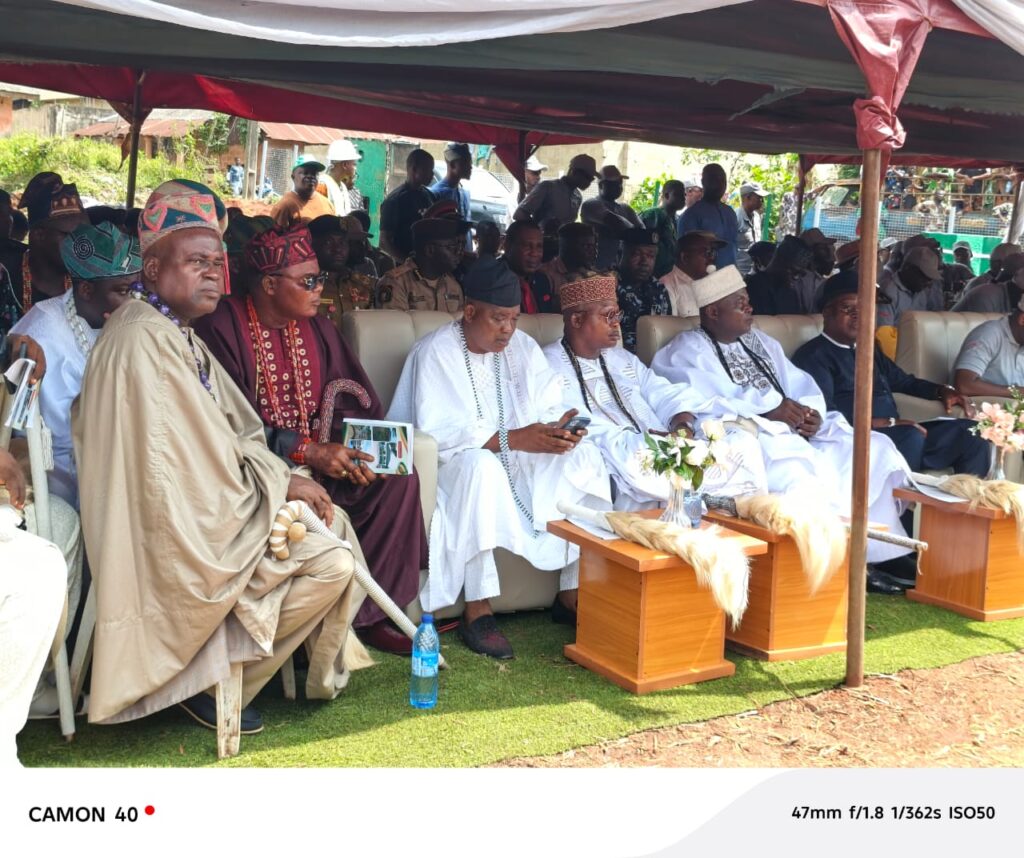
The Comptroller-General called on the benefiting communities to ensure the proper utilisation and maintenance of the facilities, describing them as enduring legacies for present and future generations.
He further disclosed that the community development initiative was not limited to Ijofin and Idiroko, revealing that the Service had continued to undertake similar interventions in other parts of the country.
He cited the recent commissioning of a community health centre in Onne, which he said was serving residents of the area.
Adeniyi assured the people of Ijofin and Idiroko that the commissioning of the four projects would not mark the end of the Service’s engagement with them.
“What we are doing today is just a milestone in our continuous relationship with the people of this area,” he said.
He emphasised the importance of traditional rulers, local authorities, community leaders and other stakeholders in promoting peaceful coexistence and effective border management.
While appreciating the cooperation extended to Customs officers by host communities, he urged residents to sustain their support for the Service and other security agencies.
He particularly appealed to the people to reject smuggling and support legitimate economic activities, stressing that effective border security required the cooperation of residents.
The Customs boss expressed confidence that the community would continue to support security agencies rather than engage in activities that undermine border security and the nation’s economy.
He also commended the officers and personnel involved in the planning, coordination and execution of the projects, acknowledging their contributions to the successful delivery of the interventions.
Adeniyi expressed appreciation to traditional rulers, community leaders, Ogun State Government officials and other stakeholders for their support and cooperation.
He specifically recognised Babaawa Adigun, whom he described as a longstanding friend and supporter of the Nigeria Customs Service, for his contributions over the years.
The ceremony was attended by senior officers of the Nigeria Customs Service, including the Zonal Coordinator of Zone A, area controllers from different commands, representatives of sister security agencies, traditional rulers, Ogun State Government officials, school administrators, teachers, youths and members of the press.
Representatives of the Benin Republic Customs administration were also present, alongside members of a delegation that travelled by boat from Badagry to Ijofin for the ceremony.