

Government is judged less by the projects it commissions than by whether those projects change daily life. Food, shelter, healthcare, education and security remain the most reliable tests of that standard. Senator Oluremi Tinubu’s visit to Ogun State on 18 August 2026 offered a clear window into how one state administration is attempting to meet those tests.
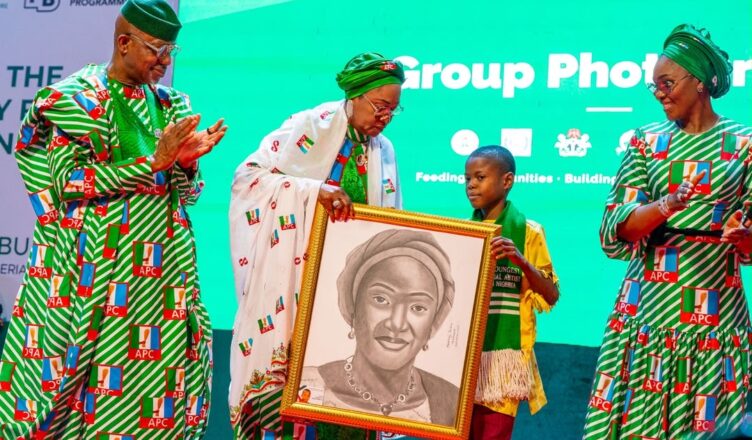
In a single day the First Lady commissioned the President Muhammadu Buhari Estate and the Gateway Medical Centre of Excellence, and witnessed the South-West zonal launch of the National Community Food Bank Programme. Later she met traditional rulers and community leaders at the June 12 Cultural Centre in Abeokuta. Taken together, the three interventions point to a deliberate focus on the foundations of human development rather than isolated prestige projects.
Governor Dapo Abiodun framed the day in those terms: economic growth loses meaning if it does not improve the basic conditions of life. “The hospitals become useful when they save lives; the houses fulfil their purpose when they shelter families,” he said. The visit simply made that philosophy visible.
Rescuing stalled housing and expanding access
The President Muhammadu Buhari Estate is not a green-field success story. When the Abiodun administration inherited the site along the Abeokuta–Sagamu corridor it was largely undeveloped. Infrastructure contracts had been awarded, a single show building stood, and legal disputes with the original contractor remained unresolved. Left alone, the project risked becoming another abandoned public investment.
Instead the state resolved the contractual issues and restructured the scheme as a public-private partnership. Government provided land and basic infrastructure; private developers handled construction and marketing. The result is 108 units of four-bedroom detached and semi-detached duplexes, complete with tarred roads, street lighting, water, power, security and recreational facilities.
Commissioner for Housing Jagunmolu Akande Omoniyi has been explicit that allocation is open to any resident who meets the published affordability criteria, not restricted to political allies. For the households that will move in, the estate represents more than housing stock: it is security of tenure, improved living conditions and a tangible reduction in one of the most visible markers of under-development—inadequate shelter.
The episode also illustrates a practical developmental lesson: stalled projects can be recovered when governments are prepared to renegotiate, introduce alternative financing and insist on completion rather than perpetual inauguration ceremonies.
Bringing specialised care closer to home
Healthcare infrastructure only delivers developmental value when it improves health outcomes and reduces the cost—financial and human—of seeking care. For years many Nigerians have travelled long distances, or left the country entirely, for specialised treatment. The shortage has often been of equipped facilities rather than trained personnel alone.
The 250-bed Gateway Medical Centre of Excellence in Abeokuta is intended to close part of that gap. Equipped with modern medical infrastructure, it aims to expand Ogun’s capacity for specialised care and reduce the need for residents to seek treatment elsewhere. Governor Abiodun described the facility as part of the administration’s broader “Building Our Future Together” agenda: projects that improve quality of life and position the state as a destination for accessible, high-quality healthcare.
The real developmental test will come after the commissioning—the number of lives saved, the reduction in medical tourism, safer deliveries, and families spared the uncertainty and expense of long-distance care. In human-development terms, a functioning specialised hospital is an investment in both health indicators and economic productivity.
Targeting hunger at the most vulnerable
Nutrition sits at the base of the development pyramid. Without adequate food, gains in housing and healthcare are quickly undermined. The South-West zonal launch of the National Community Food Bank Programme therefore carried particular weight.
Three food banks opened simultaneously in Sagamu, Yewa North and Abeokuta South, prioritising children under six, pregnant women and lactating mothers. The programme is deliberately linked to primary healthcare centres so that vulnerable households can be identified systematically and support directed where need is greatest. Governor Abiodun called it a significant step against food insecurity and malnutrition. The First Lady urged other South-West governors to replicate the model in partnership with the National Primary Health Care Development Agency.
Minister of Agriculture and Food Security Abubakar Kyari highlighted a further developmental dimension: connecting food assistance to local agricultural production and structured procurement. Done properly, the approach can move beyond emergency relief toward a more sustainable system that supports both vulnerable households and local farmers.
For families facing rising living costs, the immediate value is simpler—food on the table, better nutrition for young children and pregnant women, and a measure of resilience against hunger.
From projects to accountable development
The First Lady’s meeting with traditional rulers and community leaders underscored a final, often neglected, element of developmental governance: delivery does not end at the ribbon-cutting. Hospitals must be managed, estates maintained, food programmes protected from leakage, and infrastructure kept functional. Grassroots institutions and citizens themselves are essential partners in that accountability.
Viewed together, the events of 18 August offer a snapshot of an administration trying to translate development rhetoric into interventions around the most basic human needs. A stalled housing project was recovered and opened to ordinary residents. A major medical facility was completed to expand specialised care. A food-bank programme was launched to reach the most vulnerable, especially mothers and young children.
These are distinct interventions, yet they converge on a single developmental objective: measurable improvement in the quality of everyday life. Success will not be recorded on commissioning plaques. It will be visible in families that move into decent homes, patients treated closer to home, and children who go to bed having eaten. That is the standard against which the gains on display in Ogun State will ultimately be judged. standard against