


By Olamilekan Jaji
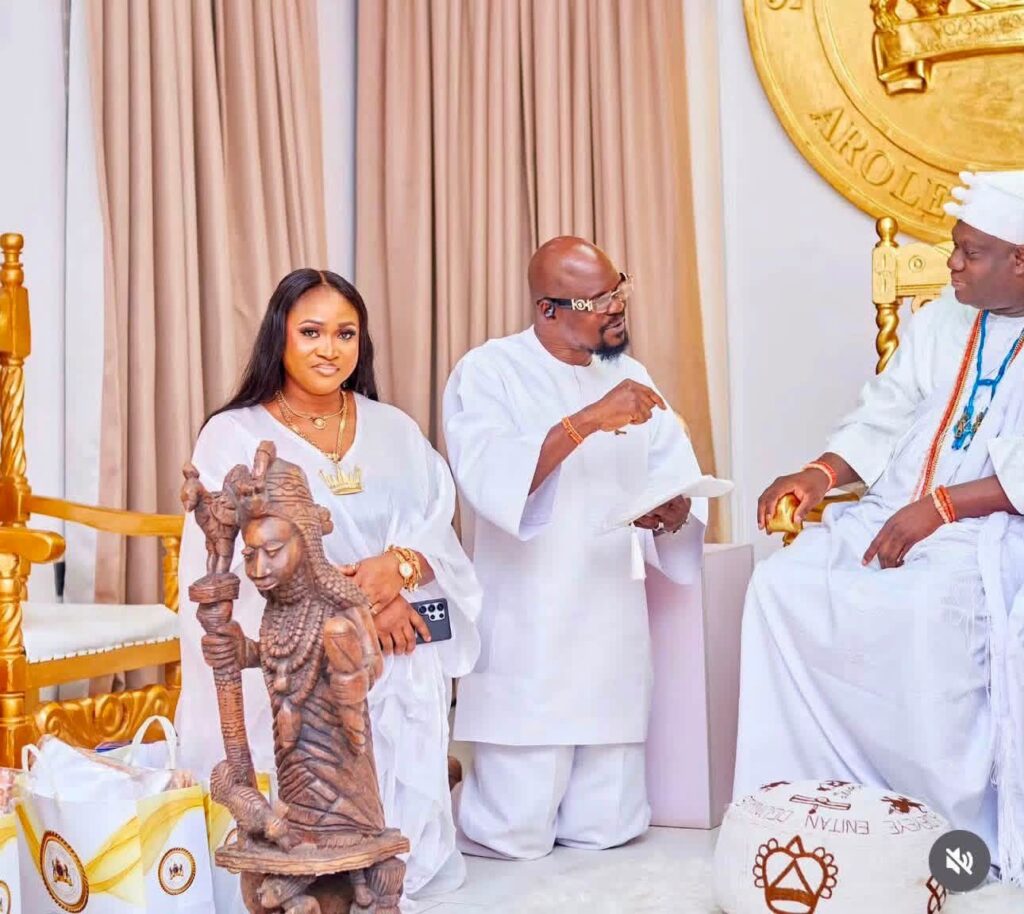
Last week, a release from the Ooni’s Palace announced that the Ooni of Ife, His Imperial Majesty Oba Adeyeye Enitan Ogunwusi, received Nollywood actor Olanrewaju James Omiyinka, popularly known as Baba Ijesha, gifting him a brand new car and the honorary title Baba Awada Kọngẹ̀. The event, which also celebrated the actor, his wife Mrs. Folashade Tokunbo Omiyinka, and their newborn son, King Kagar Omiyinka, has reignited public conversation on two issues: the weight of traditional titles in the age of virality, and the strategy some celebrities adopt to claw back into public favour.
The Weight of a Title, The Weight of a Past
Traditional titles are not props. In Yorubaland, they are custodians of memory, character, and communal trust. Baba Awada Kọngẹ̀ — loosely, “Father of Grand Comedy” — is an honorific that ties the bearer to Ile-Ife’s heritage of wit, wisdom, and moral instruction through laughter. When such titles are conferred on figures with unresolved public controversies, two things happen at once: the institution’s cultural capital is tested, and the recipient’s image is placed under a harsher spotlight.
Baba Ijesha’s case is instructive. The actor-comedian was convicted in 2022 by a Lagos court on charges related to sexual assault of a minor — a matter that drew national outrage and triggered a difficult conversation about accountability in Nollywood. His prison term was later reduced on appeal, and he has since been released. That record cannot be erased by a car key or a palace photo-op. And that is precisely why the path to redemption must be different from the path of media stunts.
Contribution vs. Controversy: What Baba Ijesha Brought to Entertainment
Before his legal troubles, Baba Ijesha was a fixture in Yoruba comedy and home videos for nearly two decades. His grassroots slapstick and “area boy” archetypes gave visibility to everyday Nigerian struggles, and his skits employed dozens of crew members, costumers, and up-and-coming actors. In an industry where 70% of practitioners are freelancers, that kind of consistent work matters.
Yet the larger society often flattens Nollywood into a single false narrative: that it is a haven of scandal, quick money, and moral laxity. This narrative ignores the sector’s GDP contribution — over 2.3% to Nigeria’s creative economy as of 2024 — and the way film and comedy have become coping mechanisms for citizens navigating inflation, insecurity, and unemployment. When a prominent figure leans into marital publicity or staged rows as a “comeback,” it feeds the very stereotype that hurts the industry’s credibility at a time the country needs its storytellers most.
The Cost of Comeback-by-Controversy
In the last 18 months, we’ve seen a pattern: celebrities announce marriages, divorces, or “exposés” just before a film release or skit series. For Baba Ijesha, the Palace visit and the newborn announcement arrived bundled with gifts and titles. The public questions are inevitable:
1. It trivializes traditional institutions — When honorary titles follow headlines rather than sustained cultural service, young people begin to read chieftaincy as influencer PR, not heritage.
2. It blots the celebrity further on social media — Algorithms reward outrage. A “media row” may trend for 48 hours, but it also resurfaces old court documents, victim statements, and hot takes. The digital footprint hardens into a caricature that is harder to outrun with each cycle.
3. It distracts from real work — Nigeria’s entertainment sector is battling piracy, distribution gaps, and funding droughts. Energy spent on marital reveals is energy not spent on guild advocacy, anti-sexual-harassment policy, or training for young comedians.
A Precise Alternative: How to Rebuild a Battered Image
If the goal is a genuine return to stardom and service, the blueprint cannot be controversy. It must be consistency. Here’s what that could look like for Baba Ijesha, using the platform he’s just been given:
The Larger Lesson for Nollywood and Nigeria
We are in a fragile season. Fuel costs, food prices, and youth unemployment have made Nigerians cynical about institutions — from government to monarchy to film. When a traditional throne and a controversial entertainer meet, it should not produce memes. It should produce mentorship, standards, and a new model of comeback: one where redemption is earned in community halls and editing rooms, not on Instagram Live.
Titles are not blotting paper for scandals. They are lamps. The only way Baba Ijesha — or any public figure — can prove Baba Awada Kọngẹ̀ means something is to make the next headline about a child he protected, a dialect he preserved, or a young comic he trained.
That would be a comeback worth celebrating.